Some relationships don’t break because of one big event. Sometimes, they erode slowly through a series of moments, misunderstandings, differences, and things left unsaid. And sometimes, by the time you realise how far things have gone, there is no easy way back. I have experienced something like that in my own life. I don’t want to get into the details. Some things are too personal to turn into content, and some relationships deserve privacy even when they have profoundly changed us.
But the experience left me with a question that stayed with me long after the circumstances themselves had passed – How much of what we believe about another person is actually based on what we have experienced, and how much is shaped by the stories we repeatedly tell ourselves about those experiences?
At the time, I was fairly certain about my perspective. I had my reasons, interpretations, and a version of events that made sense to me. And thats perhaps how most of us function! We experience something and we form opinions about it. Then, almost instinctively, we notice things around us that support that opinion. I didn’t realise how relevant this thought was until something rather ordinary happened on Instagram.
One day, I happened to stumble upon a reel by a psychologist (Every third person on instagram is now a self proclaimed psychologist or wellness influencer!) Anyway, she spoke about something that resonated deeply with what I had been experiencing and thinking about… and quite naturally I watched it – may be twice!
Then Instagram showed me another. Then another!
And then another!
Different psychologists / people / accounts / videos – but increasingly similar ideas.
If I’m being honest, a little unsettling…but something deep inside also made me feel good as my thoughts were getting reaffirmed and agreed upon by others! I hadn’t gone searching for those videos. I hadn’t typed out a question. I had simply watched one Reel.
But Instagram had noticed!!! And once it figured out that this was the kind of content I was likely to watch, it began serving me more of it. The more I watched, the more the algorithm learnt. And the more the algorithm learnt, the more my feed began to resemble my own thoughts.
I wish I had asked myself then – ‘Was Instagram helping me understand what I was going through, or was it simply getting better at manipulating me?’
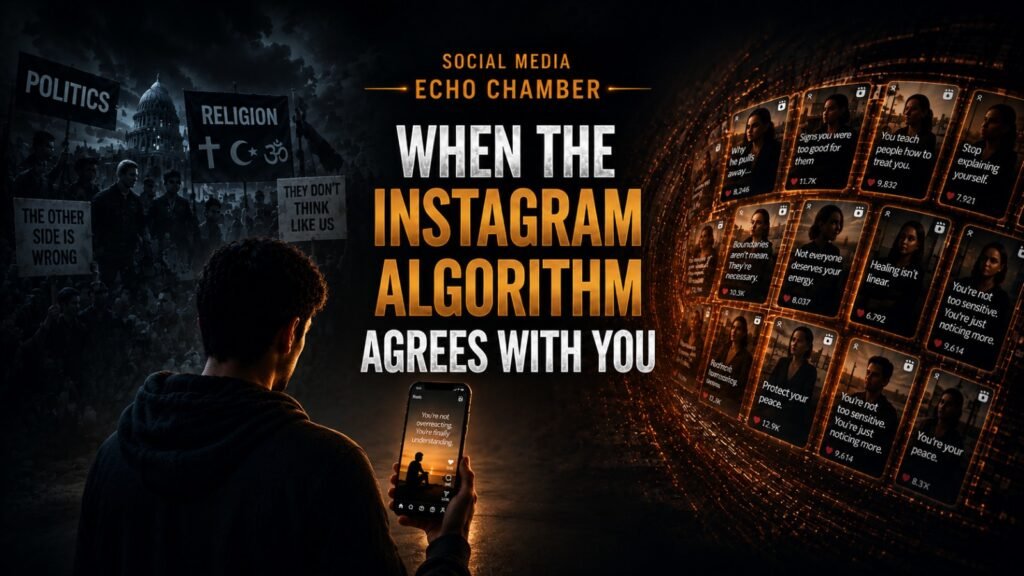
I was trapped inside a Social Media Echo Chamber!
Social Media Echo Chamber is a digital environment where users only encounter opinions, beliefs, and information that match and reinforce their own views. Opposing ideas are kept out or mocked, making personal biases grow stronger while dividing groups and increasing social or political anger.
Social media echo chambers can turn a passing thought into a firmly held belief, and a firmly held belief into a polarising identity. Whether it is religion, politics, ideology, health, or the way we perceive other people, the same algorithm can keep feeding us one side until the other side almost disappears. And perhaps, without realising it, we are not just becoming more certain – we are becoming a zealot, and more divided.
When the algorithm traps you in!
Instagram has sophisticated machine-learning models that rank content for reels, feed, explore etc. At a high level, these machine learning models, take a large number of data about both the content and the user. It then uses them to show more posts, predict how the user will behave (like, share, comment, follow etc), and then rank the content accordingly. With every interaction, instagram learns! It’s scary – insta perhaps know more about us and our behaviour, than we ourselves do!
The data points captured can include whether you watched a reel completely, how quickly you skipped it, whether you replayed it, liked, commented, shared or saved it, whether you followed the creator, whether you visited the creator’s profile, and your previous interactions with similar content.
In simplified terms, the system is effectively calculating something like:
- How likely is Rajiv to watch this Reel?
- How likely is he to like it?
- Share it?
- Save it?
- Continue watching after it?
The system is not simply showing me content; it is continuously refining its prediction of what I am likely to consume next.
The algorithm is optimising for predicted engagement, not for whether an opinion is objectively correct.
If content supporting an existing belief consistently generates more engagement from me than content challenging it, the system has a perfectly rational reason, from its optimisation objective, to recommend more of the former.
That can create a reinforcement loop: my existing belief influences what I engage with; my engagement influences what the algorithm recommends; those recommendations expose me to more material supporting the belief; and that repeated exposure can make the belief feel increasingly familiar, normal and validated – I become a zealot!
The algorithm doesn’t have to convince me that I am right. It only has to become very good at predicting that I will enjoy being told that I am right.
Are We More Divided Than Ever?
The more I think about it, the more I realise that this isn’t merely an Instagram problem. Social media has fundamentally changed the way we encounter information. We no longer all see the same newspaper front page, the same television debate or even the same set of opinions. We increasingly live inside personalised information environments.
The Reuters Institute’s Digital News Report, based on more than 95,000 people across 47 countries, found that social platforms have become an increasingly important gateway to news, particularly through video-led platforms such as YouTube, TikTok and Instagram. (Read the summary here) And when the information reaching us is increasingly filtered through systems designed to predict what we will engage with, it becomes remarkably easy for two people living in the same city, the same country, or even the same family, to inhabit completely different versions of reality.
We see the consequences everywhere-
- Politics becomes less about understanding the other side and more about defeating it.
- Religious beliefs become increasingly tribal.
- Ideologies become identities.
People don’t merely disagree anymore; they begin to distrust, ridicule and sometimes even hate those who think differently.
And the irony is that research on social-media polarization is more complicated than the popular narrative suggests. We bring our biases, identities and tribal instincts to the algorithm, and the algorithm learns how to serve them back to us.
Which brings me back to where this story began. I was looking at something deeply personal through a particular lens, and then I found an entire digital world that seemed to agree with me. For a while, that felt comforting. It felt like validation. But perhaps validation is not the same thing as truth. Today, I try to remind myself that whenever my feed seems to tell me, “Everyone thinks this way,” there is another question I need to ask: “Or is this simply what the algorithm has learnt I want to see?”
Because perhaps the greatest danger of an echo chamber is not that it prevents us from hearing other opinions. It is that, after hearing our own opinions echoed back often enough, we forget they were opinions in the first place.
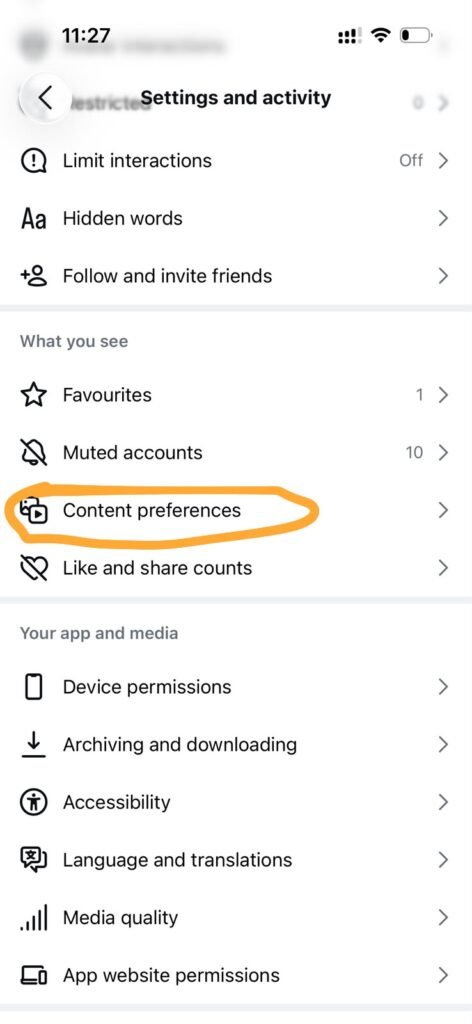
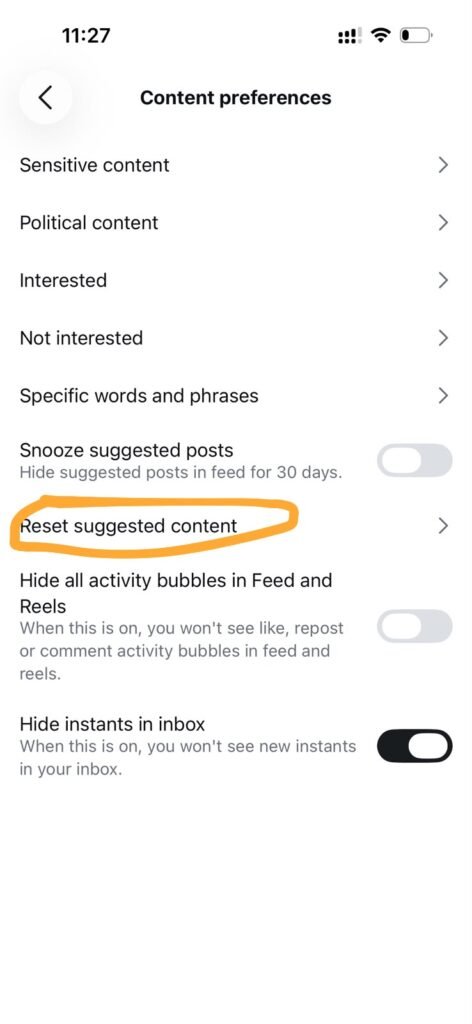
💡 Pro Tip: Reset Your Instagram Feed
If you feel like your Instagram feed has become an echo chamber, constantly showing you the same opinions, themes and perspectives, you can actually take steps to reset what Instagram recommends to you.
Instagram allows you to reset your recommended content, giving its recommendation system a chance to start learning from your interests again. It doesn’t erase your account or your followers; it essentially gives you a cleaner slate for the content Instagram recommends to you.
Think of it as resetting the algorithm’s assumptions about you.
I’ve added a simple step-by-step guide below with screenshots showing you how to do it. And perhaps, after reading this article, it might be worth asking yourself one more question before you reset:
“What do I want my feed to teach me?”
To reset the echo – chamber, go to your profile, tap the three-line menu in the top right, select ‘Content preferences’, and tap ‘Reset suggested content’