An Insecure Child Who Wanted to Be Heard
I wasn’t a confident child, especially when it came to speaking. Very early in life, I became aware of what it feels like to be seen without respect. Not because of anything I had done, but simply because of how I was perceived. That feeling stays with a child. It quietly shapes how he looks at himself.
I carried that awareness everywhere – to school, to conversations, even into silence. Somewhere around the age of ten, I decided that I needed to change how the world saw me. And in my young mind, I came up with what now feels like a very silly solution…and looking back, today, I’m glad I did that, albeit naive! I thought, if I could speak good English, proper sentences, strong vocabulary, confident delivery, then people would take me seriously – they would listen and they would value me.
It sounds naive today, but that belief became my armour. I wasn’t chasing language for marks or for a career. I was trying to reclaim dignity. I was trying to be heard.
Looking back, psychology makes sense of it. Children often use what is called compensatory coping – they try to strengthen one visible skill to deal with a deeper insecurity. It connects to ideas like Adler’s compensation theory and the concept of self-efficacy described by Albert Bandura. When you feel inadequate in one area, you instinctively try to build strength somewhere else to restore balance.
For me, language became that space. I read more. I listened carefully. I practised deliberately. And over time, that effort did far more than improve my English. It trained my mind to organise thoughts, to choose simple and precise words, and to express myself clearly – not just in English, but in Malayalam as well.
Two weeks ago, at around 11 pm, I received a call from 24 News TV Channel, asking if I could join a debate the next day on excessive exercise and its impact on health. It was on short notice. I hadn’t prepared any structured notes. But the subject itself wasn’t new to me. Years of coaching, writing, and working with clients at SOLVE and NuvoVivo had already given me enough clarity on the topic, and I agreed to be there for the debate.
The debate aired 4 days after the shoot. Messages started coming in. People said I spoke with clarity. Some appreciated how crisp the points were. A few even asked me how I had learned to articulate my thoughts like that.
That question stayed with me.
Because the truth is, I had never consciously analysed it. I never sat down to “learn communication” as a formal skill. But when I paused and traced it back, the answer was obvious. It went back to that insecure child who simply wanted to be heard.
What began as a coping mechanism slowly turned into competence. Over the years, repeated practice did its quiet work – reading, teaching, coaching, writing, debating, explaining complex ideas in simple ways. Just like fitness, communication improved through consistent reps.
And that is really what I want to share here – not tricks, not shortcuts, but habits. Habits that anyone can build, one small step at a time.
Bus Rides, Comparisons, and Silent Practice
I still remember those private bus rides back from evening classes. The bus would be filled with students from the nearby Kendriya Vidyalaya – Naval Base, and from schools like TocH and Choice – places where children spoke fluent, effortless English. I would sit there listening. In my mind, their English sounded polished, confident, almost sophisticated. It wasn’t just a language; it felt like power.
I, too, studied in an English-medium school – at least on paper. But I knew the difference. And I could feel that gap every single day.
That gap bothered me more than I admitted to anyone.
I wanted to close it. Desperately.
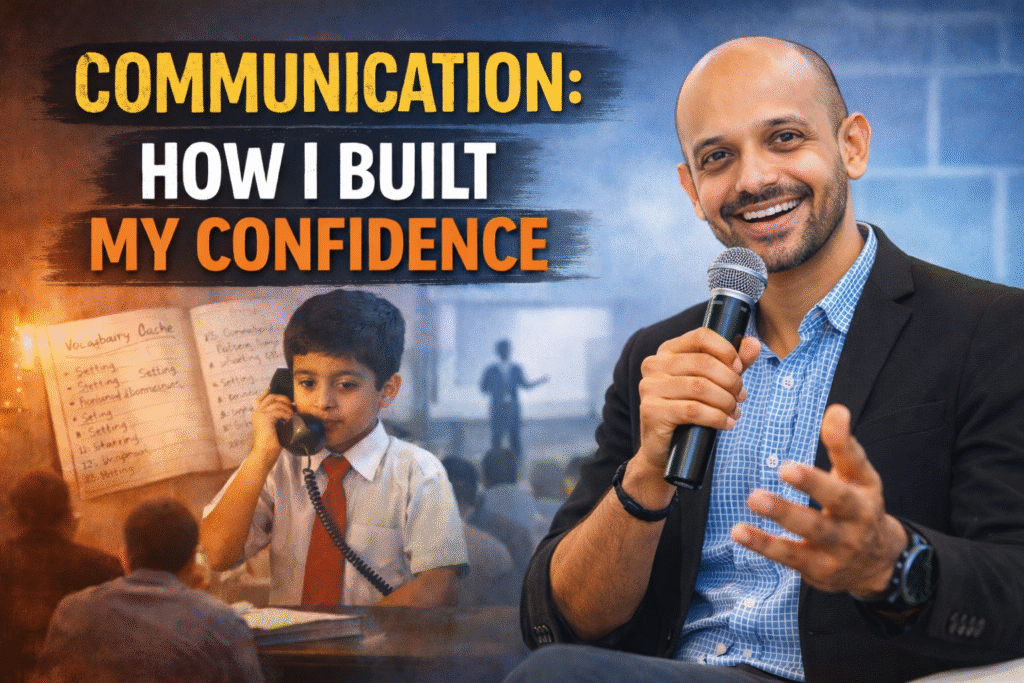
So I came up with a strange solution. I would return home, open the old yellow-pages telephone directory, choose random office numbers, and dial them. When someone answered, I would speak in English, ask for an imaginary person, and attempt to leave a message. There was no real purpose to those calls. I just wanted to hear myself speak.
Behind the safety of a telephone line, I was invisible. Nobody could see me. Nobody knew who I was. Nobody could judge the boy on the other end. It became my private rehearsal room – a place where I could stumble, correct myself, and try again without embarrassment.
Today, it sounds almost ridiculous. But when I look back with kindness, I realise something important. That child wasn’t being foolish. He was protecting and trying to build his self-worth
Later, when I joined NSS College of Engineering, something important happened, almost by accident. In our third semester, my friend Sreenath and I signed up for a paper presentation conducted by the Electrical Department. We didn’t enter with big expectations. We were competing against final-year students who, in our mind, were far more experienced at presentations.
But we won third prize! And there was prize money!!
I still remember that moment. The money was decent pocket money for two college students. But what stayed with me was something deeper. For the first time, I felt that my ability to explain something clearly had value. Not just in my head, but in the real world. That small win changed something inside me.
Presenting became a thrill. Not because of the applause alone, but because each time I stood up to speak, I felt myself growing stronger. We began applying to every paper presentation we could find. Every stage became practice. Every audience became feedback. Every competition added a layer of confidence.
Around the same time, another quiet habit was forming. On my brother-in-law Kuttettan’s insistence, I began reading The Hindu editorials regularly. I would also watch ‘Asia Business Report’ by BBC, every day in the morning at 7 am, while having breakfast just before leaving to the college. I also carried a small diary where I wrote down words I didn’t understand. I would form two sentences for each word to learn its usage. And I would then, deliberately try to use those words in conversations. I must admit – it often sounded forced and people could tell. I would feel awkward, but gradually, the awkwardness reduced. The words began to fit in naturally into my conversations. My vocabulary improved, and eventually people would poke fun of me as – ‘Sasi Tharoor‘ or ‘Pritviraj‘, but I secretly rejoiced hearing that. And more importantly, not just my vocabulary, my thinking too became sharper with that.
Somewhere along the way, I realised something else crucial – good communication is not just about displaying vocabulary. It is also about structure and timing – what to say first, what to leave out, when to pause, when to simplify, when to repeat a word or a sentence!
The paper presentation competitions pushed me further. I began practising in front of a mirror and watched my expressions. I corrected my pronunciation, worked on pauses and modulation. The ADHD in my would make me speak fast often, but I trained myself to slow down and emphasise key points.
That period became my real communication training. Not in a formal classroom, but in small college halls, in front of unfamiliar faces, making mistakes, correcting them, and trying again.
Those were my early reps. And they built more than I realised at the time
Interviews Became Easy, But Work Taught Me More
By the fifth semester of my engineering, companies began arriving on campus for interviews. By then, something had shifted in me. At the risk of sounding arrogant, interviews no longer felt intimidating. I was confident, that if I could clear the initial technical interviews, the HR rounds or group discussions would be a walk in the park! Years of paper presentations, mirror practice, and reading had trained me to organise my thoughts quickly and speak without freezing. What once made me anxious had slowly become comfortable.
As far as job offers were concerned, I was spoilt for choices. By the time I graduated, I had four job offers and I chose to join General Electric (GE) in Hyderabad.
That phase of life taught me a different lesson – one I hadn’t anticipated.
Until then, I believed communication was about language, clarity, and confidence. At GE, I was exposed to international crowd – my job required communicating with clients in China (GE Sensing), and Europe (GE Industrial). I realised culture plays an equally powerful role in communication.
My work required frequent telephonic calls to the GE China offices.. Even simple things became very complicated to communicate. From names like Lee, Xi, or Ming, I couldn’t tell whether the person was male or female. I would dial the office number, speak to the receptionist, and hesitate for a split second – should I say “him” or “her”? On top of that, I had to consciously slow down my speech so they could follow my accent.
One particular call to Shanghai is still fresh in my memory. I said, “Good afternoon, can I speak to Ming?” The receptionist responded with a firm, flat “No!”
I was taken aback. It felt abrupt. It felt very rude.
Only the next day, did I realise, when I received an email from Ming that she was on leave the previous day and was not at office. What the receptionist simply meant was that Ming was on leave that day and hence she cannot transfer the call to her office desk. I learnt that there was no hostility in it. Just a difference in tone, language style, and cultural expression – and perhaps a lack of vocabulary to communicate the exact thing she meant.
That moment stayed with me!
It taught me that communication is far far more than vocabulary or fluency. It is also about listening carefully, understanding context, being patient, and respecting differences. You may speak perfect English, but if you fail to understand the person on the other side, communication still breaks down.
And that was a humbling realisation.
I’m not an expert in communication training, and I don’t have a fixed method. These are just habits that worked for me and let me share them in case they are useful to you.
- Read every day, even if it’s 15 minutes: Reading good writing (like news paper editorials) teaches structure without you realising it. Focus on how arguments are built, not just on new words.
- Keep a vocabulary diary: Write down words you don’t understand and use them in two sentences. Don’t force them into conversations immediately. With time, they come naturally.
- Practice speaking out loud: Talk in front of a mirror or record yourself. Notice your speed, pauses, and pronunciation. Communication improves only when you hear yourself.
- Teach someone what you learned:Teaching clients or friends forced me to simplify science into daily language. If you can explain it to a high school student, you have understood it well.
- Structure before you speak: Think in three steps – problem → explanation → solution. This keeps your speech crisp and helps listeners follow your thoughts.
- Use simple words, not big words: Clarity is more powerful than vocabulary. People remember ideas that are easy to understand. That said, there are certain words that convey the context and meaning beautifully as against explaining that one single word / feeling in a whole sentences. If its important and helpful, use them!
- Slow down: Speaking slowly improves clarity and confidence. It also gives your brain time to organise thoughts.
- It’s ok to fumble! This is a big one. fumbling for words and adding fillers (once in a while) are ok. Quite often, people relate to you..and being relatable is a very big positive while communicating
- Listen carefully: Communication is half listening. Understand the other person’s background, culture, and expectations before responding.
- Repeat in different situations: Paper presentations, coaching sessions, articles, TV debates – all were practice sessions. Like fitness, communication improves with consistent reps.
- Confidence comes with preparation: Know your subject well. When you understand a topic deeply, words come naturally.
Two weeks after the debate on 24 News, when I got a message on Instagram yesterday, congratulating me – not just for the points I made, but for the clarity with which I spoke, I paused and thought about it..What that insecure ten-year-old decided to work on, hoping for a little more acceptance and self-worth, had quietly become one of my biggest strengths.
That ten-year-old wanted to be heard, and he turned out to be exactly right..and thank you universe for that!