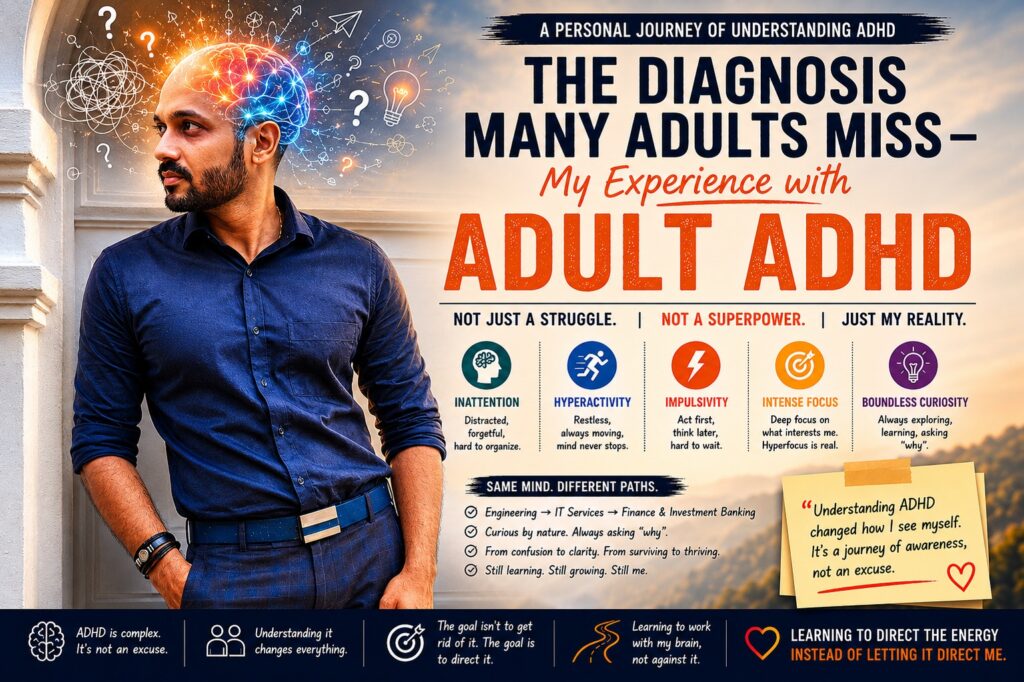
Like many people, I associated ADHD with children who could not sit still in class, were visibly hyperactive, or struggled academically. I never imagined that adults who function well, build careers, manage responsibilities, and appear productive could also have ADHD.
The first person to challenge that assumption was my Psychology PG classmate, and now a dear friend, Dr Ruby. In the very first week of our psychology course, she casually told me, “You know, I think you have ADHD.”
I remember almost dismissing it instantly. – “Oh please!”
At that point, the idea seemed ridiculous to me. I had worked across industries, completed an MBA, managed teams, built businesses, and generally done well professionally. Yes, I was always juggling too many things at once, had more ideas than I could execute, left things till the last minute, and functioned unusually well under pressure – but I thought that was just my personality.
A few months later, our classes progressed into the DSM-5 classification of Neurodevelopmental Disorders, and Dr Marykutty Mam started teaching us about ADHD. As she went through the characteristics, something started to feel uncomfortably familiar!
- Difficulty sustaining attention unless genuinely interested.
- Hyperfocus.
- Mental restlessness.
- Starting with enthusiasm but struggling with routine.
- Procrastination despite capability.
- Feeling like you are constantly working harder than necessary to stay organised.
At some point, I stopped listening as a student and started listening as someone who was quietly checking boxes in his head. Then I turned back and looked at Dr Ruby, and she just smiled!! A smile that said, “I told you so,” without saying a word.
That moment did not diagnose me, and this article is not about self-diagnosis either. But it was probably the first time I stopped dismissing the possibility and started paying attention.
What Exactly Is ADHD? And Can Adults Have It Too?
ADHD (AttentionDeficit Hyperactivity Disorder), is a common neuro-developmental condition that affects how the brain develops and functions, especially in areas related to attention, impulse control, activity levels, planning, and organisation.
People with ADHD typically experience patterns of:
- Inattention: difficulty sustaining focus, getting distracted easily, forgetting things, or struggling with organisation
- Hyperactivity: physical or mental restlessness, constantly feeling the need to do something, or difficulty slowing down
- Impulsivity: acting quickly without fully thinking through consequences
The extent of each of these can vary significantly from person to person. Not everyone with ADHD experiences all three in the same way or to the same degree.
Based on the extend of the ADHD is usually grouped into three broad presentations:
- Predominantly Inattentive
- Predominantly Hyperactive – Impulsive
- Combined Type (features of both)
For example, when I started understanding ADHD better, I realised that I scored much higher on the hyperactivity side – not necessarily in the sense of running around physically, but in terms of a constantly active mind, always wanting to do more, think more, start more, and stay engaged. On the other hand, I did not relate as strongly to severe attention difficulties as I had imagined ADHD would require.
That was another surprise for me …. ADHD is not one fixed profile; it can look very different from one person to another.
In children, ADHD may look like constantly moving around, interrupting others, difficulty following instructions, or struggling to sit still. But ADHD does not automatically disappear with age.
In adults, it often looks very different. Instead of running around physically, the restlessness may move into the mind. Adult ADHD may show up as poor time management, chronic procrastination, difficulty completing projects, disorganisation, mental overload, or feeling like simple tasks require more effort than they seem to for others.
There is no cure for ADHD, but it can be managed very effectively through a combination of behavioural strategies, structure and routines, coaching or therapy, lifestyle changes, and where appropriate, medication.
That was probably my biggest surprise too….not that ADHD existed, but that adults could have it and not realise it for years.
The Same Traits Can Build – Or Break
One thing I realised while reading more about ADHD was that the very traits that create challenges can sometimes become strengths, if they are channelised well. Children with ADHD are often highly active, highly curious, process information quickly, and can be impulsive. That combination can be a double-edged sword.
Without the right structure, support, or environment, that energy and impulsivity can sometimes lead to risk-taking behaviour, poor decisions, or drifting into unhealthy patterns. But when directed well, the same energy can become persistence, curiosity, learning, and achievement.
Looking back, I think I got lucky. My hyperactivity did not disappear…it simply found things to attach itself to.
At different stages of life, that energy got channelled into competitive entrance exams, then MBA entrance preparation, and perhaps that is one reason I could sustain interest through a highly technical field like electronics engineering, work in IT services, later switch into finance and investment banking, spend years reading financial statements, following stock and bond markets, tracking budgets and macroeconomic policy, and then make another complete shift into nutrition, fitness, lifestyle disorders, and psychology.
When I look back, the pattern was never that I stayed in one lane. The pattern was that I kept wanting to understand more.
Even today, while my work is in health and wellness, my curiosity spills into completely unrelated areas. I find myself reading about quantum physics, mathematics, how calculus gets applied to modern problems, geopolitics, and at different points I have even tried learning Spanish, Mandarin, and now Arabic.
But I want to be careful here…I am not glorifying ADHD.
The same mind that becomes deeply curious also becomes restless and overwhelming too.
I still find it unusually difficult to stand in a queue and patiently wait my turn. When someone is explaining something, there are times I feel like my mind has already predicted the next two sentences and moved ahead, which sometimes makes me interrupt unintentionally and may appear impatient and rude.
I still procrastinate. I still have days where I wake up with enormous enthusiasm and decide to do ten things at once …like writing this article today! …And other days where everything feels mentally crowded and I do not feel like doing much at all.
Understanding ADHD did not make these things disappear. But it helped me realise that not everything I struggled with was a lack of discipline, and not everything that helped me succeed happened despite ADHD either. The challenge, at least for me, has been learning how to direct the energy instead of letting the energy direct me.