Eat fat to lose fat!
That idea caught my attention when I first got interested in health and fitness around 2014. Keto was everywhere, and this concept felt almost revolutionary. It went against everything we had been told about fat. But I was convinced, as if I had uncovered something most people didn’t understand.
I bought into it quickly. In my head, the logic was simple: if the body burns fat in ketosis, then eating more fat should help you burn more fat. It felt clean, straightforward, and made perfect sense at the time.
Looking back now, it feels almost ridiculous how confidently I arrived at those conclusions with such limited understanding. But at that stage, I didn’t know what I didn’t know.
My thinking wasn’t limited to nutrition. Like many others, I also believed that building muscle was the ultimate sign of health. If you looked muscular, you were fit. That was the goal. That was the definition. Everything else felt secondary.
Over time, as I started learning more about nutrition, physiology, and even psychology, I began to see how incomplete my understanding was. Health wasn’t a single variable. It wasn’t just diet or muscle. It was far more layered, and often, less certain than I had assumed.
One thing I’ve realised through this journey is that learning doesn’t happen just by accumulating information. It requires a small but important shift in mindset – the willingness to accept that you might be wrong. Even a tiny possibility is enough. Without that, you don’t question what you already believe. And if you don’t question, you don’t learn.
Keeping your eyes and ears open helps. But more importantly, keeping your mind open does.
It took me some time to realise that what I experienced wasn’t unique. There’s actually a well-known concept in psychology called the Dunning – Kruger Effect.
Dunning – Kruger Effect
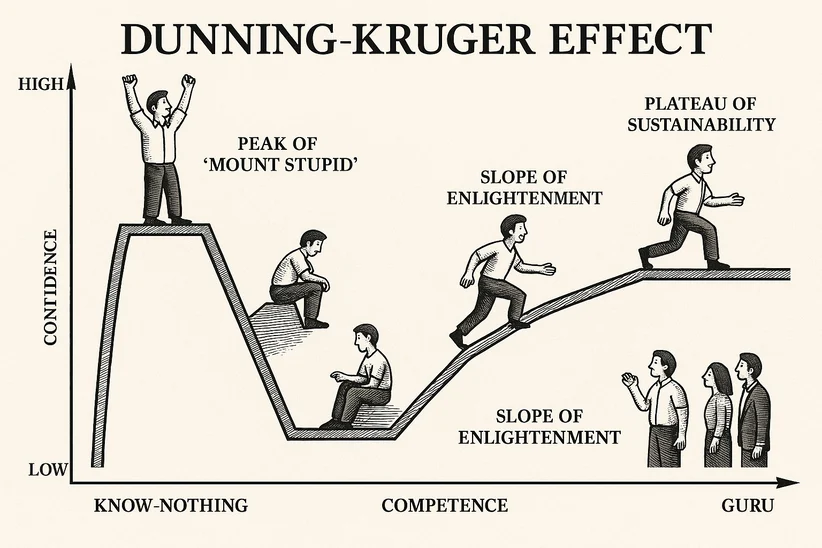
The Dunning–Kruger Effect refers to a cognitive bias where people with limited knowledge or competence in a subject tend to overestimate how much they actually understand. First described by psychologists David Dunning and Justin Kruger in 1999, it highlights a simple but important problem: when you don’t know enough, you also lack the ability to recognise what you don’t know.
Because of this, confidence tends to be high in the early stages of learning, even when understanding is shallow. When you know a little, it’s easy to feel like you know a lot.
But as you start learning more, you begin to see the gaps. You realise the subject is far more complex than it first appeared. And interestingly, your confidence often drops.
Looking back, I can clearly see myself going through this phase between 2014 and 2015, when I started my journey in health as a coach. The confidence I had about keto, fat loss, and muscle building didn’t come from deep understanding. It came from knowing just enough to form strong opinions, but not enough to question them.
I had simple models in my head. Eat protein, and it becomes muscle. Train hard, build muscle, and that equals health. It all felt straightforward.
That started to change when I began reading standard textbooks like Biochemistry by U. Satyanarayana and Lehninger Principles of Biochemistry. As I went deeper, many of my assumptions started breaking down. Even something as basic as protein metabolism wasn’t as simple as I thought. Protein doesn’t just “turn into muscle.”
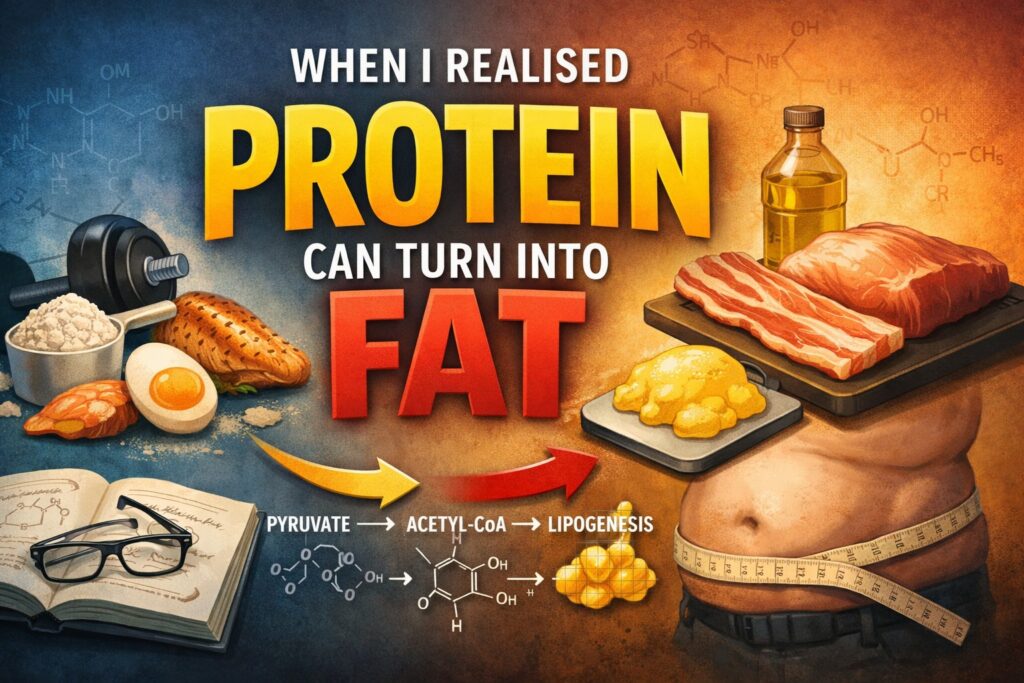
In a calorie surplus state, excess protein and amino acids can undergo deamination and enter metabolic pathways of the TCA cycle, where fatty acids are synthesised through lipogenesis, and ultimately gets stores as fat in adipose tissues!
Yes! it means – protein can become fat in the body!!!
That realisation, I remember, was both fascinating and uncomfortable. It forced me to accept that my earlier understanding was incomplete.
In hindsight, I’m actually thankful for a part of my personality here. I’ve always had a tendency to dig deeper until something makes sense. I find it difficult to sit with half-answers. That curiosity pushed me to keep going to pick up more books on nutrition, human physiology, biomechanics, and anything related to health that I could find. At one point, I even bought Davidson’s Principles and Practice of Medicine, not because I needed it immediately, but because I felt I didn’t know enough.
There was a phase where this almost became uncomfortable. The more I learned, the more I realised how much I didn’t know. That drop in confidence is what the Dunning – Kruger curve refers to as the “valley of despair.”
But that phase was important.
As I continued learning, my certainty reduced, but my understanding improved. I started questioning my earlier beliefs instead of defending them.
And that shift, from confidence to curiosity, is what really changed how I look at health.
What this journey made me realise is that learning is not just about adding new information. It is also about recognising the limits of what we already know.
The Dunning – Kruger Effect is not just something that applies to others; it applies to all of us. At different points in our lives, we are all confident about things we don’t fully understand. And the more strongly we believe something, the harder it becomes to question it.
That is where our own belief systems can become a barrier. Once we form an opinion, especially one that has worked for us or feels intuitive, we tend to defend it rather than examine it. This slows down learning. It keeps us in a loop of reinforcing what we already think, instead of expanding our understanding.
What helped me move forward was a simple shift – leaving a small possibility that I might be wrong. That one change opens the door to better questions, deeper learning, and more balanced decisions.
This has been an eye-opener not just for health, but for everything we think we know. Because the real challenge is not lack of information, it is the confidence we place in incomplete understanding.
The more you learn, the less certain you become. And that is not a weakness. It is a sign that you are finally seeing things more clearly.
Addendum: How Protein Can Turn Into Fat (A Technical Explanation)
After publishing this article, quite a few people reached out asking the same question…how exactly can protein turn into fat in the body? One of my friends even called me up, slightly annoyed, and accused me of using that line as clickbait 😛
That got me thinking.
The next morning, I decided it would be useful to explain this properly, and from a more scientific perspective. So brace yourself.. I’m going to get a bit technical here !
To understand this, we need to first recognise that the body does not have a storage form for excess protein. Unlike carbohydrates (stored as glycogen) or fats (stored as triglycerides), amino acids cannot be stored in large amounts. So when protein intake exceeds the body’s requirements for repair and maintenance of various tissues including muscles (muscle growth etc), and other functions, the excess protein has to be processed.
This begins with deamination – a process where the nitrogen component of the amino acid is removed and excreted as urea. What remains is the carbon skeleton, which can enter central metabolic pathways.
At this point, metabolism becomes context-dependent.
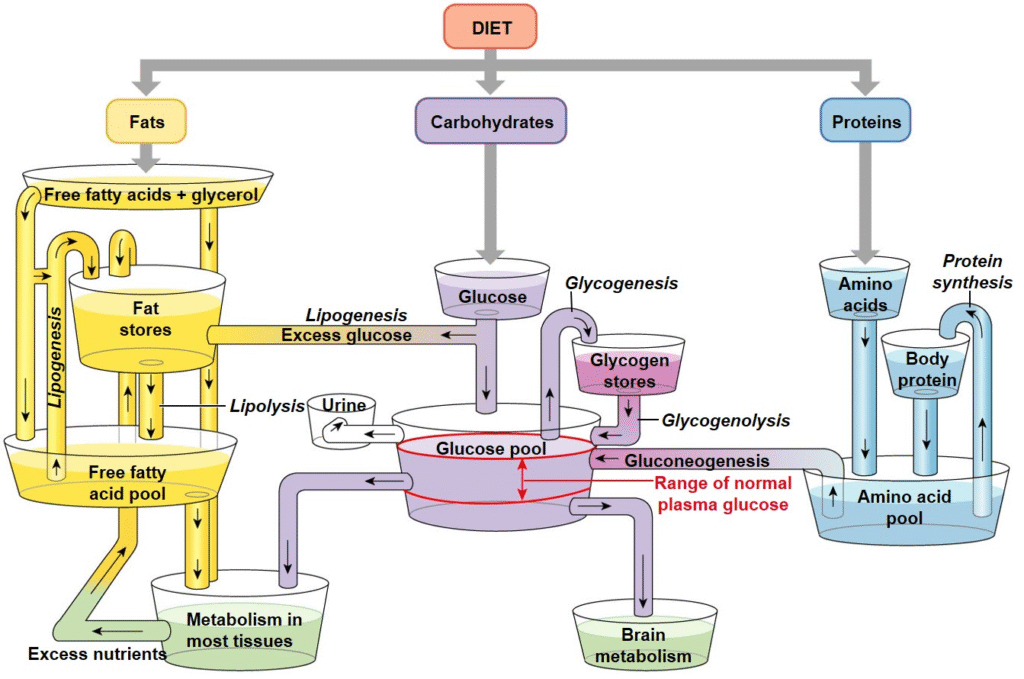
Now, if you look at the diagram above, you’ll notice another important pathway called gluconeogenesis, where the amino acid pool (ie, broken down individual components of protein) is converted into glucose and moved to glucose pool! This glucose then enters the glucose pool in the blood.
From here, two things can happen:
- If the body needs energy, then it gets used immediately
- If glycogen stores are not full, then it gets stored as glycogen (glycogenesis)
However, if glycogen stores are already full and you are on a calorie surplus, this excess glucose derived from protein is diverted toward lipogenesis – process of creating fatty acids for storage in fat cells
So excess protein becomes glucose, and that excess glucose get converted into fat when your calorie intake is in surplus.
In short, if you take excess protein and end up in calorie surplus, you gain fat!!!! ie, protein got converted into fat in the body
At the same time, as mentioned earlier, some amino acid carbon skeletons can also directly enter pathways that lead to acetyl-CoA, which is another precursor for fatty acid synthesis.
So whether directly or indirectly, the outcome is the same. In a calorie surplus, the body will find ways to store excess energy – and that storage form is fat.
This doesn’t mean protein is “bad” or that it should be avoided. It simply reinforces a broader point – the body works as an integrated system. No nutrient acts in isolation, and what ultimately matters is the overall energy balance and metabolic context.
Hence the Dunning Kruger Effect of learning 😂