Recently I was invited to a podcast where the host asked me about anabolic steroids used in bodybuilding. During the conversation I explained something fairly straightforward – something the scientific world has long known and proven beyond doubt. i.e – anabolic steroid use for body building can affect the health badly, and specifically the heart health. It can enlarge the heart (cardiomegaly), disturb lipid profiles, increase blood pressure, and in some cases increase the risk of heart attacks. Nothing controversial there! This is standard medical knowledge and has been discussed in cardiology literature for years.
The conversation went on for a while, but as social media prefers life in 60-second capsules, the media team also clipped a short reel from the discussion and posted it on Instagram.
Soon the comments started coming in. Most were normal. But then there was one particular comment in Malayalam (see below)

Which roughly translates to: “Get the hell out of here dude! If we don’t use these steroids, does that mean we won’t get heart attacks?”
Now, the argument by the above gentleman is quite fascinating!. It belongs to a special category of reasoning (or lack of it) that is surprisingly common in public conversations – especially related to science. Refuting such arguments are often time consuming and very energy consuming.
Often their logic goes like this:
- People who never exercise can get heart attacks. Therefore exercise is useless.
- Some non-smokers get lung cancer. Therefore smoking warnings are exaggerated.
- Some people who eat healthy food still fall sick. Therefore diet doesn’t matter.
At this point I briefly felt the urge to reply with something sarcastic..and I even got a very good retort for the comment – a famous line from the Malayalam movie, ‘Mazhathullikilukkam‘

I wanted to quip that line, and follow it up with a calm explanation of physiology, logic, risk factors and perhaps a small lecture on common sense! 🤦♂️
But, then, I paused!
Because I remembered something called Brandolini’s Law!
Brandolini’s Law says that – The amount of energy required to refute nonsense is an order of magnitude greater than the energy required to produce it.
In simpler terms, writing that entirely stupid and silly comment probably took him about 4 – 5 seconds.
For me, explaining why it was wrong would take:
- atleast 10 – 15 minutes of typing, and explaining physiology
- another ten minutes explaining the concept called ‘logic’, and breaking my head thinking how can someone not understand something as simple as this
- and possibly the rest of the evening wondering why I bothered to explain to him (Which is the worst and most daunting!)
And after all that effort, there is still a decent chance that the response would be read for 3 seconds, followed by another comment saying – “Still not convinced bro.”
I had to remind myself – The internet has a lot of people who have infinite confidence and limited curiosity. Albert Einstein famously said – ‘Two things are infinite: the universe and human stupidity; and I’m not sure about the universe.’
And if you try to explain every flawed argument you encounter online, you may soon find yourself spending your life explaining basic logic to strangers on Instagram.
That, in essence, is the quiet tyranny of Brandolini’s Law.
I thus refrained from commenting..but I figured, this is a brilliant topic to write a blog about, in my website. 😀
The Psychology Behind It
Certain psychological tendencies make us more receptive to quick, confident claims
- Cognitive Ease: The brain prefers ideas that are simple and easy to understand. When something sounds straightforward and familiar, we tend to accept it without much scrutiny. For example, a statement like “Drink lemon water every morning to detox your body” is easy to grasp and sounds logical. Explaining that the liver and kidneys already perform detoxification and how those physiological systems work requires far more effort.
- Confirmation Bias: People naturally favour information that supports what they already believe and ignore or dismiss information that contradicts those beliefs. For example – Weight training is the best exercise and cardio and yoga are pointless.
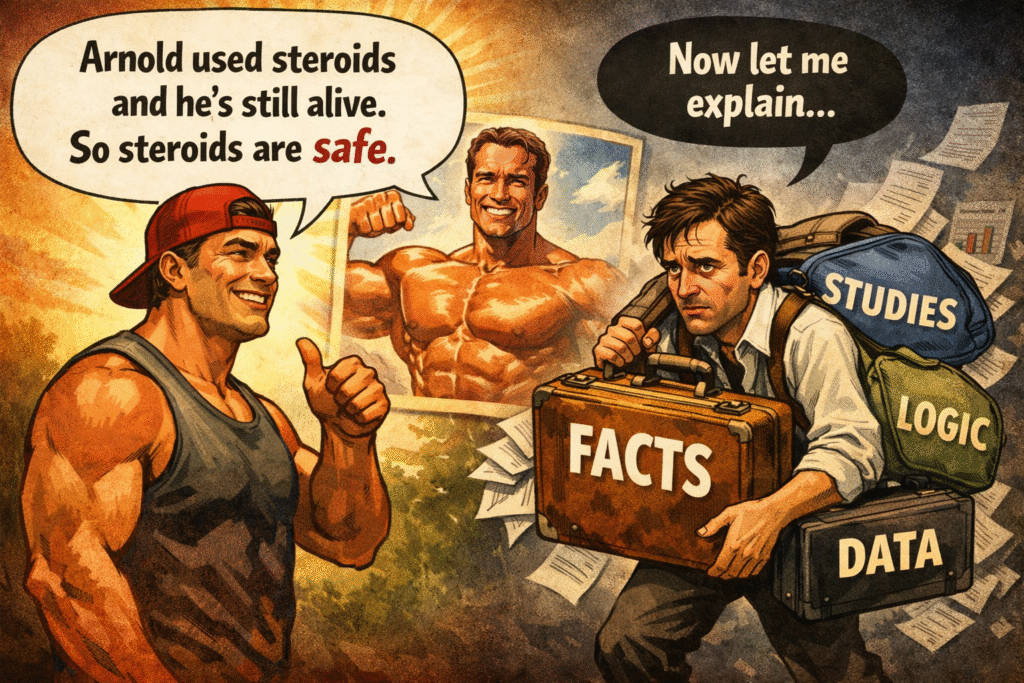
- Survivorship Bias: Survivorship bias happens when people focus on the small set of data / people that succeeded or survived and ignore the larger set / people who did not succeed. The classing example I got in the comments sections that fit into this logical fallacy is – “Look at Arnold Schwarzenegger. He used steroids and he’s still alive and doing well”
- Confidence Bias: In everyday conversations, confidence is often mistaken for competence. A person who speaks with certainty can appear more convincing than someone explaining evidence carefully. Classic example is – “Bro, steroids are completely safe if you know how to cycle them,” may sound convincing simply because the statement is delivered with certainty, even if the speaker has no medical understanding of the risks involved.
- Emotional Reasoning & Cognitive Dissonance: If an idea feels right or aligns with our hopes, fears, or personal experiences, we are more likely to believe it, even if the evidence is weak. For someone chasing rapid muscle growth, the idea that steroids are “not that dangerous” feels reassuring. The emotional desire for looking muscular and good can make the risks easier to dismiss – a sort of cognitive dissonance
- Ad Hominem Attack: This is the lowest level of the lot! An ad hominem argument attacks the person instead of addressing the argument. When evidence becomes inconvenient, the easiest strategy is to shift the focus to the person making the argument – commenting on appearance, mannerisms, or personal attributes. Some of the funny and extremely brainless comments i received where about my mottathala (skin-head), my mannerisms , my appearance. The logic is – If I undermine the person, I don’t have to address the argument. Let’s discredit the messenger so that the message can be ignored! Once the conversation moves into personal attacks, the effort required to bring it back to reason becomes even greater – Brandolini’s Law at play again!
Together, these tendencies create an environment where quick claims gain traction easily, while careful explanations demand more patience, attention, and intellectual effort from the listener.
Argument, Identity, and the Cost of Correct Thinking
Public argument has always been a part of Indian intellectual life. In fact, Amartya Sen famously described this tradition in his book ‘The Argumentative Indian’, a society where debate, discussion, and disagreement have long been part of public culture.
But somewhere along the way, many conversations seem to have quietly shifted in character. What once resembled debate increasingly resembles verbal combat. The goal is no longer to understand a point better, but to defeat the person making it.
When an idea is challenged, the reaction is often immediate and personal. Instead of examining the argument, the conversation quickly moves to the person by questioning his motives, competence, appearance, or credibility. The discussion drifts away from evidence and toward identity.
In such an environment, explaining something carefully becomes a surprisingly expensive exercise – more so, if it is related to health and wellness. A claim can be made in a sentence. A sarcastic comment can be posted in seconds. But explaining physiology, probability, risk factors, or long-term consequences takes patience and attention and above all thorough knowledge – commodities that are sadly not always abundant in social media conversations.
Not because facts are unavailable, but because reasoning requires effort, and effort is rarely as attractive as a quick retort.
In the end, Brandolini’s Law explains something most people who try to discuss science, medicine, or even basic logic eventually discover the hard way. A careless claim can be written in ten seconds, posted in a comment box, and sent confidently into the world. Correcting it, however, requires explaining physiology, statistics, probability, and sometimes even elementary reasoning – none of which fit comfortably into an Instagram comment thread.
The strange economy of social media comments sections therefore works like this: nonsense travels light, while explanation carries luggage. And if one tries to unpack all that luggage every time a random comment appears online, one may soon discover that the internet has an unlimited supply of nonsense but a very limited market for explanations.
Brandolini’s Law, in that sense, i feel, is more of a practical survival guide and less of a scientific principle – and very relevant for anyone who still believes in the value of thinking things through!